Best Infrared Thermometer for Kitchen Use
Cooking is both an art and a science. It requires knowledge of food preparation, different cooking methods, understanding various ingredients and their combinations, and self-expression. For the most part, however, cooking is about temperature control. And what better tool is there for temperature control than a thermometer?
Thermometers are staple tools in the kitchen, especially in commercial kitchens where accuracy and consistency are a must. Moreover, you may have noticed infrared thermometers used for quick temperature checks of hot food and cold beverages at restaurants’ buffet line holding stations. You don’t need to be in a professional kitchen to benefit from temperature control. An infrared thermometer for the kitchen can help you with that. Here are some infrared thermometer kitchen tips and hacks.
Sommario
Using Infrared Thermometers in the Kitchen
Why are infrared thermometers suitable for kitchen use? For the same reason, they are used for other purposes – they allow you to read the temperature quickly and conveniently from a safe distance.
This means you don’t have to touch, especially extremely hot surfaces, to get an accurate reading. It is ideal when you cannot insert a probe into the object in question, whether it is out of reach or simply too hot and dangerous to touch.

What you need to know about infrared thermometers
Infrared thermometer kitchen limitations:
Before we go deep into the rabbit hole of the different uses of infrared thermometers in the kitchen, you must know their limitations.
While they are great for cooking, infrared thermometers measure the surface temperature of an object. Thus, they do not provide an accurate reading of the object’s internal temperature. It means you cannot use this thermometer as a substitute for a good old meat thermometer or an instant-read thermometer for cooking.
Moreover, infrared thermometers may require adjustments depending on the surface of the object you are measuring (emissivity, or the object’s ability to emit infrared energy).
Various surface particles, such as dirt, dust, moisture, frost, fog, or smoke, can temporarily affect the thermometer’s ability to provide an accurate reading. In the same way, proximity to radiofrequency radiation with an electromagnetic field strength of at least 3V/m can affect its reading.
You also cannot use this thermometer to measure the water temperature inside the glass. If you do so, you are simply measuring the glass’s surface temperature.
On Cooking Liquids
Infrared thermometers are ideal for measuring the temperature of liquids such as soups and sauces. You must pull the spoonful of liquid from the bottom up and point the thermometer at it. It will give you a good idea of the batch’s temperature. Whether it’s your first batch of soup or leftovers from last night’s dinner you are reheating, bringing the liquid to 165° F for at least 20 seconds ensures it is ready and safe to eat.

On Cooking Semi-Solids
You can also use this thermometer for mashed potatoes, corn, or other semi-solid stuffing that needs to be cooked and kept at a specific temperature. It is essential to ensure you have killed off any bacteria in the food. To use the thermometer, poke the food in the center using a spoon and pull it up carefully to create a hole. Then point the thermometer into the hole. It should read at least 165° F before the food can be considered safe and ready to eat.
On Cooking Protein
You can also use the infrared thermometer to quickly check the temperature of the pan, pot, or skillet for searing, roasting, or cooking chops. The temperature should reach 500° F.
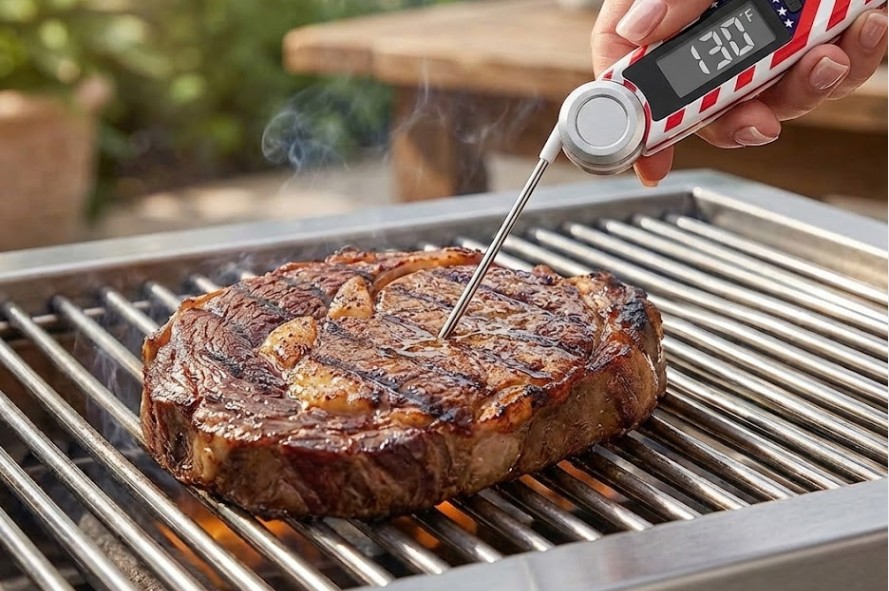
For completeness, however, it is still best to use the probe thermometer, as inserting the probe is the only way to measure the meat’s internal temperature. It is essential, especially when working with thicker-cut meats that need to be brought (and cooked) to a specific internal temperature.
On Hot Oil Temperature Check
An infrared thermometer is also ideal for checking the oil for deep frying (such as for cooking batter-dipped chicken). It provides a fast, accurate, and safe alternative to stem thermometers. To ensure the oil is ready, point the thermometer at the oil. The temperature should be at 350° F.
However, note that an infrared thermometer cannot truly measure the temperature of anything shiny, such as a dry steel pan. They are ideal for cast-iron and matte-finish pans.
With that said, you can use a quick point-and-shoot infrared thermometer to check whether the oil in the pan, pot, or skillet is ready, which should be at 500° F.
On Baking Pizza
To achieve the correct crust, texture, and flavor of the pizza, one should bring the pizza oven to the appropriate and even temperature. However, the oven’s interior can reach a scorching 900° F. Moreover, many built-in oven thermometers are highly inaccurate. This is why oven temperature can only be measured with heavy-duty, commercial-grade thermometers – unless you have an infrared thermometer.
Since an infrared thermometer lets you measure the temperature of objects from a distance, it is a safer way to ensure the oven is at the right temperature. It is, however, essential to note that you are only measuring the wall of the oven with an infrared thermometer.
The Takeaway
An infrared thermometer is incredibly versatile and convenient in the kitchen. It removes the guesswork and helps you ensure the food is cooked thoroughly and is safe to consume. In addition, an infrared thermometer is safer and more convenient than other thermometers. But as said in this entry, it has its limitations too. You have to understand where and when to use one in the kitchen.
Scopri altri prodotti ChefsTemp
Scopri altre ricette e impara trucchi di cucina unendoti alla nostra famiglia di cuochi su Facebook.
Potrebbe anche interessarti: