The Chefs Temp Guide to Everything You Need to Know About Steak: Temperatures, Ordering, and Buying
To know about the steak temperature chart, let’s first know what a steak is. A steak is a cut of beef from the muscle. Usually, the hindquarters or the upper back part of the animal are affected. These muscles are soft and mostly marbled with fat. Steaks are thick cuts of muscle cut across the grain. Let’s see the different cuts, the internal temperature at which the steak has to be cooked, and various tips to order them in a restaurant, and some tricks to cooking them at home, with a clear knowledge of the steak temperature chart and, importantly, how to measure the temperature using a meat thermometer.
All about Steaks and Meat Thermometers
Temperature plays a major role in deciding the doneness of a steak. Based on temperature, steak doneness can range from blue to well done. There are many different cuts of steak, such as sirloin, rib eye, porterhouse, New York cut, T-bone, and filet. Irrespective of the cut, the cooking temperature guidelines are the same. Of course, different cuts would be better suited for different types of serving. That’s why a meat thermometer is a must when cooking steak. First, one should know what the steak temperature is all about.
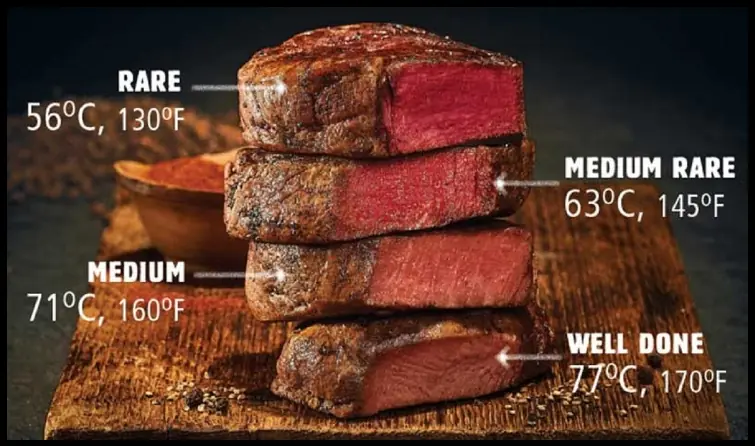
When the steak is seared at 110°F (43℃), it is a blow because only the outer part is cooked in a hot pan or grill, and the inner temperature of the meat stays cool and uncooked. Cooking the steak from 120°F (48℃) to 130°F (54℃) results in a “rare steak,” with warmer red meat inside. Cooking the steak to an internal temperature of around 130°F (54℃) to 145°F (62℃) is known as medium-rare. If it is done at 145°F (62℃) to 160°F (71℃), it is a medium steak. A well-done steak is cooked to 160°F (71℃) to 170°F (76℃). These temperatures should be measured using a meat thermometer. Judging by color often leads to overcooking or, at times, undercooking. The USDA does not recommend cooking meat below 145°F (62℃). Using an instant-read meat thermometer would be more convenient, as the temperature difference between the doneness levels of different types of steak is only 5 to 10 degrees. An instant-read meat thermometer would give readings instantly, within seconds. One thing to note is that even after removing the meat from the fire, it will continue to cook within it and experience a temperature rise. So, it is always better to take the steak out of the fire 5 to 7 degrees lower than it needs to be. Using the best meat thermometer would be helpful for this.
Different Steak Cuts
The following are the common types of steak cuts:
- Sirloin: The tenderness of this cut varies depending on its location. The upper sirloins are more tender than the lower ones. It has chewy skin inside it. That is not liked by many. That’s why its cost is somewhat lower than other steak cuts. It has less fat, so health-conscious people would prefer it.
- Rib-eye: The rib-eye steak has two parts, namely the eye and the cap. This type of cut is preferred by most people. It is marbled nicely with fat throughout the meat. It is very soft and gives off a beautiful aroma. A steak with a well-marbled eye and a thick cap would be a perfect choice.
- The New York strip is the most popular one. It is more flavorful and very soft. The strip steak with even marbling is a better choice than the New York strip.
- Filet: also known as fillet mignon, it has somewhat less flavor than the rib eye or the New York strip. It is a cut made from the tenderloin. The available portion of a fillet in a whole piece of meat is relatively small. So it costs more.
- T-bone: As the name implies, it’s a cut of meat with a T-shaped bone. There is often a small amount of filet, which makes cooking troublesome for beginners, as the fillet will overcook before the steak reaches the required temperature.
- Porterhouse: It is a T-bone steak with a good amount of filet. So, when cooking this kind of meat, one should keep in mind that there are two types of muscle, and the reverse sear method is best suited.
Grilled, baked, or cooked in a pan or on the BBQ, an electronic meat thermometer is always the best tool to get the desired doneness of the steak.

Order Steak Like a Pro
Often, people are disappointed when their expectations for a steak are not met at a restaurant. It is because one orders the steaks the wrong way. If one wishes to have a medium steak and would refer to the waiter as a steak that is pink inside, it is a vague statement. If one wants a steak medium, it is better to say medium; otherwise, it is better to specify the preferred temperature, as this article makes one aware of the different temperatures in the steak temperature chart. As most restaurants do use digital thermometers nowadays, it would be a nice call to ask for the desired temperature.
When selecting a steak, it is always advisable to choose one that is well-marbled, as the fat between the muscles will melt during cooking and add more flavor to the steak. A better understanding of the steak temperature chart and the use of a meat thermometer to check the steak’s temperature would help cook every cut of steak more deliciously.
Discover Other ChefsTemp Products


Discover more recipes and learn kitchen tricks by joining our cooking family on Facebook.
You may also like: