The Advantages and Disadvantages of Infrared Thermometers
Before they became popular in the medical field, infrared thermometers were already used for a wide variety of temperature-monitoring purposes, including aeronautics, military, industrial, engineering, electronics, and even the kitchen. They are the thermometer of choice for most home cooks as they are super easy and quick to use. But as with most tools, it has its strengths and weaknesses. This entry will dive deeper into that, discussing the advantages and disadvantages of infrared thermometers.
Table of Contents
Infrared Thermometers: How They Work
Before we dive deeper into its pros and cons, it is important to understand how this handheld device works.
Infrared thermometers utilise infrared radiation to determine the surface temperature of objects without physical contact. They do so by using a lens that focuses the infrared light emitted by the object onto its detector, a thermopile.
Thermopiles are essentially thermocouples connected in parallel or series. As soon as infrared radiation strikes the thermopile’s surface, it is absorbed and converted into heat. The result of this is converted into a voltage output proportional to its infrared energy. The detector converts the output into an electrical signal, which is then displayed in units of temperature (˚C or ˚F).
What is even more amazing about this device is that it can measure the temperature of a specific object while compensating for ambient temperature variations. This enables the thermometer to read temperature from a distance, without coming into contact with the object it’s measuring.
While this whole process may sound complicated, it takes just a couple of seconds for the infrared thermometer to take a temperature reading and display the temperature on its screen.
Advantages of Infrared Thermometers
- Convenient, fast, and easy to use
This is what made infrared thermometers extremely popular in the last couple of years amid the pandemic, as medical workers could quickly and easily, almost instantaneously, get a temperature reading using the handheld device.
This also makes it very convenient for them to take the temperature of their patients with severe illnesses, the elderly, young children, and infants. It helps reduce the risk of spreading disease among people, is hygienic (no contact needed), easy to use, and easy to clean.
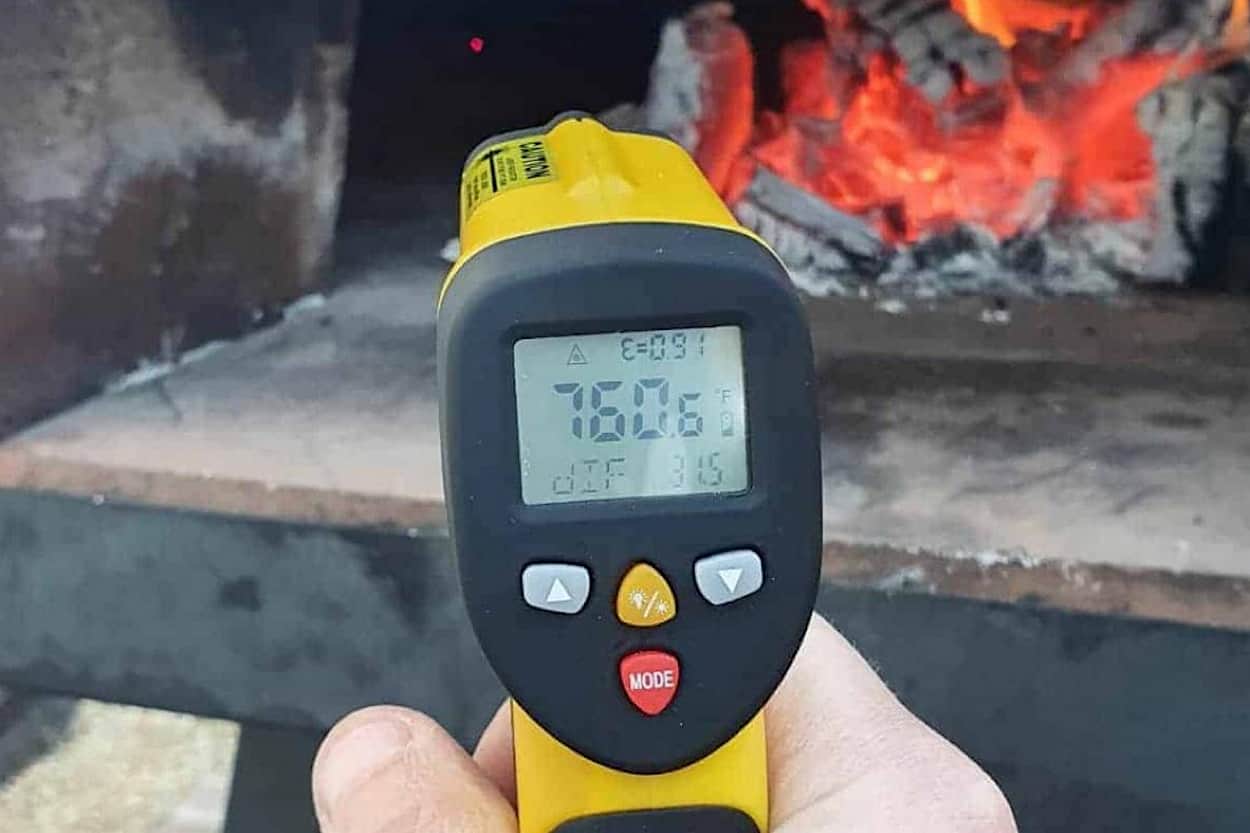
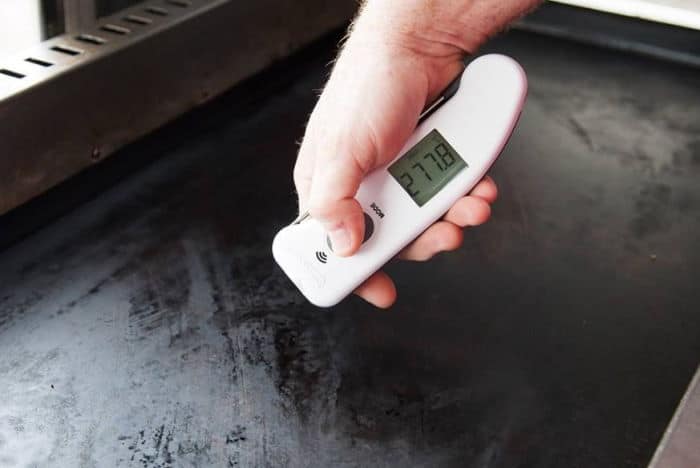
In the kitchen, the device allows cooks to get a quick, accurate reading of food temperature from a distance, which is extremely handy when working with griddle surface temperatures or verifying the temperature of an open-deck oven. This is why it is a staple tool in commercial kitchens. While the oven and probe thermometers are good for monitoring temperatures, they don’t come anywhere close to infrared thermometers in terms of accuracy, ease of use, quickness of reading, and safety.
And since you don’t need to poke your protein with a probe to measure its temperature, handheld infrared thermometers won’t mar the aesthetics of your dish, leaving your food completely intact and pristine on the plate.
Tip: Click here to find more instant-read thermometers in the market if interested.
- Reads temperature from a distance
This is by far the biggest advantage of infrared thermometers over other types. Since it can measure temperature from a distance, it allows users to get a precise temperature reading of extremely hot surfaces and items that cannot be touched (e.g., a car engine), hard-to-reach objects (e.g., measuring pipes for household repairs, soil temperature for construction), and should not be touched (e.g., food, to avoid contamination).
As a matter of fact, NASA’s latest USD 10 billion James Webb Space Telescope uses the same concept; it is designed to see through infrared light, allowing it to more clearly observe objects in the vastness of space and farther back in time than any previous telescope could.
- Measures moving parts
Portable infrared guns are also the hardware of choice for measuring moving or in-motion objects, such as motors, moving machinery, rollers, engine pulley systems, and conveyor belts, in processing plants. Since this type of thermometer is highly responsive, there is little to no delay in reading temperature differences.
Disadvantages of Infrared Thermometers
- Only takes the surface temperature
An infrared thermometer only takes surface temperature, not internal temperature. This makes it quite a tricky tool to use in the kitchen and other settings, as they may also require adjustments depending on the surface being measured. It may be able to provide a quick, accurate reading of the oil temperature in your sauté pan or confirm that the oven is preheated, but it cannot accurately measure the internal temperature of thick cuts of protein like whole chicken or turkey.
When measuring the temperature of liquid foods like soups and sauces, it is recommended that you stir vigorously before using the thermometer to obtain a more accurate reading. Also, note that steam, even when the liquid is not boiling yet, can condense on the thermometer, affecting its accuracy.
- May require adjustments
Depending on the surface being measured, the infrared thermometer may require adjustments for proper emissivity (the effectiveness of a specific surface material to emit energy as thermal radiation).
While there are charts that provide a quick reference for the emissivity of various materials, these are mostly estimates, as the actual emissivity still varies with thickness, colour, and even temperature.
Since highly polished materials are highly reflective of ambient infrared energy, they emit less electromagnetic radiation, resulting in very low emissivity ratings.
- Not as accurate as surface probes
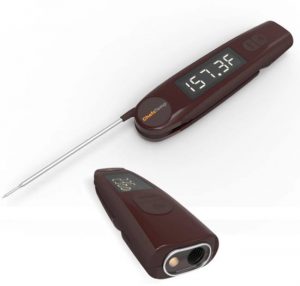
Compared to thermometers that use surface probes, the performance of an infrared thermometer can be temporarily affected by dust, fog, frost, moisture, or other airborne particles. This means the environment must be clean and without high humidity or dust for an accurate reading.
Though the difference in reading may be marginal, it can matter in certain applications where pinpoint temperature accuracy is needed.
Moreover, this type of thermometer can be temporarily affected by rapid changes in ambient temperature and by the proximity of radio frequencies with electromagnetic fields (3 V/m or stronger).
The Takeaway
As with other tools, infrared thermometers have specific purposes, advantages, and disadvantages. The disadvantages of infrared thermometers cannot outweigh their benefits. Knowing where and when to use them will give you the power to maximise this handy tool.
Discover Other ChefsTemp Products

Discover more recipes and learn kitchen tricks by joining our cooking family on Facebook.
You may also like: