The Biggest Mistakes You Make When Using an Instant Read Thermometer
An instant-read thermometer is an absolute must-have in every kitchen. Knowing how to use it, however, is even more important.
There are many mistakes people make when using a digital thermometer.
Being aware of these and knowing how to properly use your digital food thermometer is of utmost importance to keep you and your loved ones safe and healthy.
This article will dive deep into the 6 common mistakes people make when using an instant-read thermometer, along with solutions for each.
Table of Contents
Mistake 1: Using an infrared thermometer to test internal temperature
Infrared thermometers are designed to measure the surface temperature of foods and liquids.
Using them to check food’s internal temperature will not work and will lead to inaccurate readings, since the surface temperature often differs from the internal temperature for most foods.
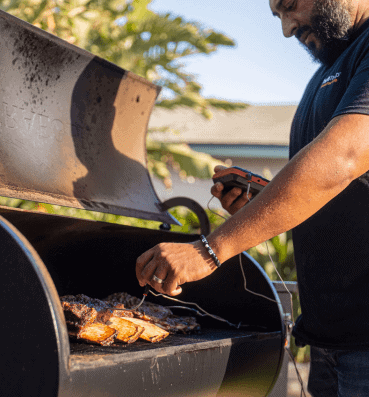
The best way to check a food’s internal temperature is using a probe thermometer. The probe penetrates the temperature layers and gets to the thermal centre of the food, giving you an accurate measure of the food’s internal temperature.

Mistake 2: Not using the instant-read thermometer correctly when temping non-solid foods

There are different layers of temperature. They are called gradients of temperature. These temperature gradients exist in ovens, fridges, coolers and foods, especially liquids and semi-liquids.
When cooking soup, for example, you’ll notice that it cooks faster from the bottom and the middle than the top. When cooling, however, the exact opposite happens: the top cools faster than the middle and the bottom of the soup.
Merely sticking a probe into the soup without accounting for these gradients will give you a false temperature reading.
Here are a few tips to help you take correct and accurate readings when temping non-solid foods:
- Stir thoroughly to even out the temperature of the food
- Guide the probe to the centre of the food
- Make sure it doesn’t touch the bottom of the pot
- Finally, temp the food. The safe internal temperature for soup is 165°F (74°C).
To get an even more accurate measurement, keep stirring the food with the probe for a few seconds while it tempers, until the temperature on the thermometer screen stabilises.
Mistake 3: Failing to use the thermometer properly when temping solid foods
While it is relatively easy to find the thermal centre of liquid and semi-liquid foods, it is a little tricky with solid foods, especially chicken.
Chicken cooks at different internal temperatures. For example, chicken breasts cook at a lower temperature compared to thighs and drumsticks.
That’s why cooking both dark and white meat to a safe temperature is crucial to ensure the whole bird is safe to eat.
Here is how to properly temp a whole chicken:
- Find the thickest part of the breast.
- Tilt the thermometer probe slightly and stick it in.
- Make sure the probe doesn’t touch the bones.
- Take the measurement. The thermometer should read 165°F(74°C).
- For thighs and drumsticks, do the same thing. These should be cooked to an internal temperature of 175°F (79°C).

Mistake 4: Not using an accurate digital thermometer
Using an inaccurate instant-read thermometer is a common mistake. To test how accurate a digital thermometer is, people often use the famous ice bath method.
While this is an effective way to check how accurate your digital food thermometer is, it is easy to do incorrectly. Simply inserting your thermometer probe into a cup or container filled with water and ice won’t give you a correct reading.
Follow these tips to go about preparing an ice bath for a correct and accurate temperature check:
- Fill a wide and tall glass with ice.
- Add cold water.
- Stir thoroughly and let rest for 1 to 2 minutes.
- Insert your thermometer probe into the glass.
- Make sure it doesn’t touch the sides or the bottom of the glass.
- Check the reading. The thermometer should read 32°F(0°C).

If you get a reading of more or less than 32°F(0°C), you can do two things. Most digital thermometers come with an offset button. If yours has it, you can recalibrate it using that button.
If not, take note of the difference and remember to subtract from or add to your reading next time you use the electronic meat thermometer to check your food temperature. Two to three degrees of difference shouldn’t be a problem. However, if the difference is more than that, consider buying a new one.
Mistake 5: Not cleaning your thermometer between temp tests
Most perishable foods, especially meat, when not cooked to a certain internal temperature, offer an ideal environment for pathogens to live and multiply. When cooking these foods, most people use an instant-read thermometer to check the temperature. The mistake most of them make is that, in between the temperature tests, they forget to clean the thermometer probe.
While cleaning a probe thermometer between temperature tests is obvious, most people overlook it. That may expose you and your family to serious foodborne illness.
Next time you want to check your food temperature, for safety, it’s imperative that you clean it before and after use. The cleaning process is easy and won’t take you long.

Simply wash the thermometer probe with hot water and soap, and you are good to go.
Mistake 6: Using paper logs instead of digital ones
We live in a digital world, where tracking, storing, and easily accessing your food temperature logs is automated, yet so many chefs still use paper HACCP logs to record their food temperatures.
Although HACCP paper logs are mainly used by professional chefs, many regular people do use them too.
Whichever category you fall into, paper HACCP logs aren’t the most time-efficient way to track your food’s temperature. They are also hard to navigate and store. More importantly, they are very prone to error.
Today, most kitchen thermometers can take accurate readings of your food temperature at different intervals and transfer the data to secure, wireless digital logs that you can then access on your PC or phone whenever and wherever you are.
These digital data loggers not only eliminate human error but also provide a reliable archive of your food’s temperature for future use.

Final Thoughts
Using an instant-read thermometer shouldn’t be a problem now that you are aware of these mistakes and how to avoid them. With the tips outlined above in mind, you can now safely use your digital thermometer to cook your food to accurate, healthy internal temperatures.
Discover Other ChefsTemp Products
Discover more recipes and learn kitchen tricks by joining our cooking family on Facebook.
You may also like: