Temperature Danger Zone:What Is It? &Why Is It Important? [2026’s Most Complete Introduction]
Do you know the Temperature Danger Zone (TDZ)? It’s also referred to as “Foodborne Pathogen Zone,” which means an unsafe food temperature range between 40°F and 140°F (4.4°C to 60°C) where Salmonella and E. coli bacteria proliferate most rapidly – often within just 20 minutes! Therefore, making our food unsafe to eat.
This article will comprehensively introduce it, explain why it’s important to keep your food out of it, and show you how to properly cook, store, and reheat your food to ensure it is safe and healthy.
Table of Contents
Part 1. What is the temperature danger zone?
The temperature danger zone is the range of temperatures where food can remain for long periods, since it provides an ideal environment for bacterial growth. According to the USDA and ServSafe, this temperature range is 40°F (4.4°C) to 140°F (60°C).
At that temperature, in as little as 20 minutes, the food becomes a perfect environment for bacteria, such as Salmonella and E. coli, to grow and multiply to dangerous levels, making it poisonous to anyone who eats it or even touches it.
Besides, 70 ° F to 125 ° F (21 ° C-52 ° C) is the absolute peak period for bacterial reproduction. Within this range, pathogenic bacteria such as Salmonella and Escherichia coli exhibit logarithmic growth, with their numbers doubling every 20 minutes under ideal conditions.

Temperatures below 40°F (4.4°C) and above 140°F (60°C) are the safest for food storage. This means that food should be cooked and reheated to over 140℉ (60℃), chilled to 40°F (4.4°C) or below, and stored in the freezer at 0°F (-17°C) or below.
Part 2. Why is the temperature of danger zone for food important?
For Food Safety
The danger zone is very important because knowing it helps you identify whether a food item is safe to eat before it shows signs of bacterial contamination.
In most cases, even if you leave food at room temperature for a few hours or even a day or more, it wouldn’t show any signs of spoilage.
The food would still look and smell normal. But if you were to put it under the microscope, you’d find out that the bacteria have already settled in.
For Food Texture
Cooling or thawing stages create significant physical differences that affect the end product significantly.
Allowing meat to slowly cool or thaw at room temperature can be disastrous. In addition to increasing bacterial growth, long exposure causes cell walls to break down prematurely, leading to extreme moisture loss and an unpleasant texture and mouthfeel.
Rapid temperature transition methods — like an ice-water bath — help quickly move food through its danger zone, maintaining cell integrity while sealing in internal moisture for greater moisture control. Accurate temperature management is vitally important for protecting meat’s structural fibers while maintaining the superior textural qualities that define an enjoyable bite experience.
Here’s a detailed table to see the differences among temp, bacterial activity, & food texture:
| Temperature Range (F / C) | Bacterial Activity (Food Safety) | Physical & Textural Impact on Meat |
|---|---|---|
| Above 140°F (60°C) | Bacteria Die. Safe for hot holding and serving. | Proteins fully denature; meat structure sets and firms. |
| 70°F to 125°F (21°C - 52°C) | Extreme Danger (Logarithmic Growth). Bacteria double every 20 mins. | Maximum risk zone. Slow cooling here causes cellular breakdown and excessive moisture loss. |
| 40°F to 70°F (4.4°C - 21°C) | Moderate Growth. Still unsafe for prolonged exposure. | Prolonged exposure leads to slow structural degradation and "weeping" (loss of meat juices). |
| Below 40°F (4.4°C) | Bacteria Dormant. Safe for cold storage and refrigeration. | Cellular integrity is maintained; internal moisture and textural qualities are safely locked in. |
Part 3. How to measure your food temperature?

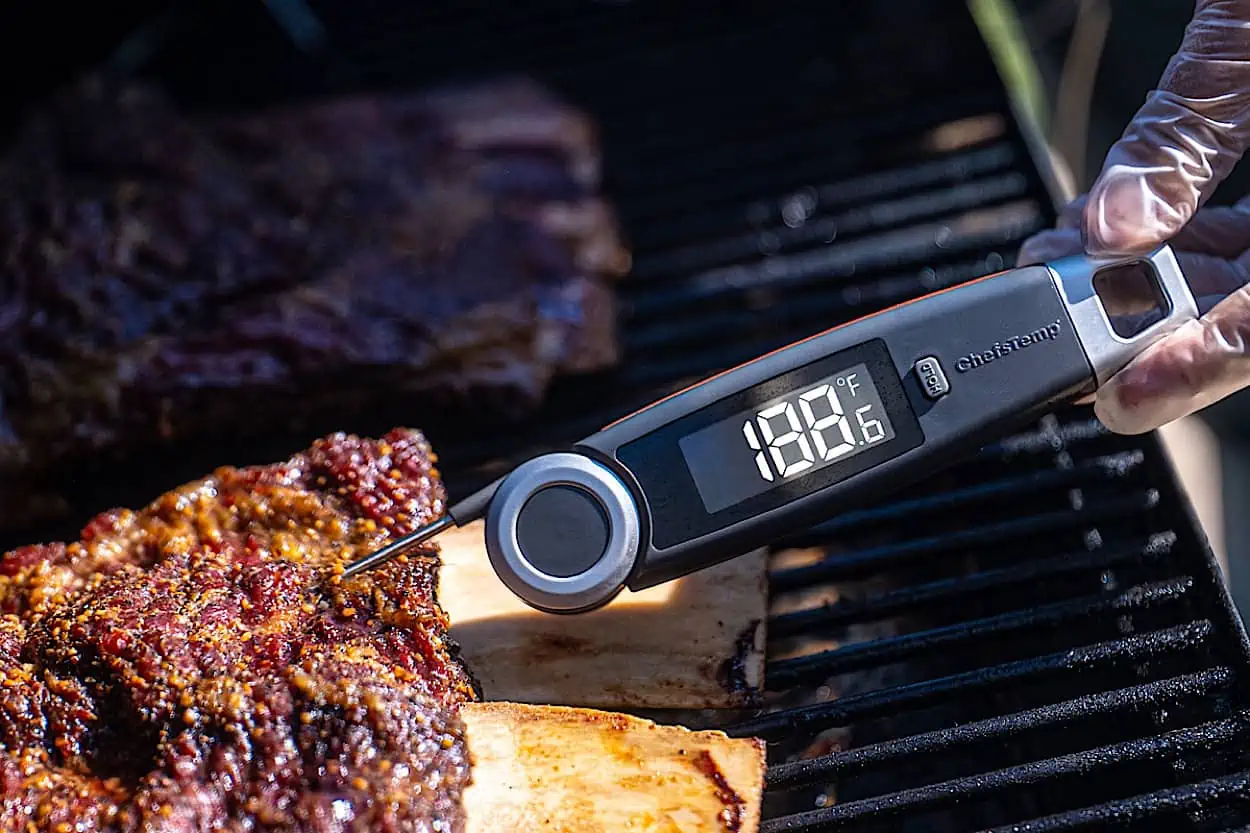
When cooking or reheating your food, it is important to accurately measure its temperature to ensure it doesn’t fall into the danger zone. Using a digital food thermometer is the safest and most accurate way to do that. A probe thermometer comes with a metal stem. When it’s inserted into the food, it gives an accurate measure of the food’s temp.
When cooking meat, poultry, or seafood, insert the instant-read thermometer into the thickest part of the meat, avoiding any bones.
For other types of food, you need to guide the probe thermometer’s metal stem into the center of the dish and away from the heat source. You don’t want the metal stem to hit the bottom of the pan. Doing that will give the probe thermometer flawed readings.
If the food you’re cooking or reheating is too low for the kitchen thermometer’s tip to reach the bottom of the pan, tilt the pan slightly so the food is on one side, then slide the probe thermometer into the middle of the food.
In addition, relying solely on surface temperature as an indicator of food safety can be disastrous. While an exterior cut of meat might appear safe to the naked eye, its thermal center often remains within its Temperature Danger Zone and needs to be monitored closely to ensure total food safety.
Transitioning away from spot checking towards continuous data monitoring involves shifting from spot checks to continuous tracking systems like the ChefsTemp S1 Wireless Thermometer Hub, which provides continuous readings rather than isolated readings. Instead of tracking isolated temperatures in specific environments, such as external temperatures and internal thermal centers, in real time, ChefsTemp keeps tabs on both simultaneously to deliver real-time analysis for an improved overall temperature reading experience.
Part 4. How to keep food out of the food temperature danger zone?
To keep food out of the danger zone, follow these 4 safety tips:
1. The four-hour rule
The safest time for food to stay in the danger zone is between 2 and 4 hours, and sometimes even less, when it is hot outside.
In that four-hour window, you need to do one of the following things with your food:
- Up to two hours: Any ready-to-eat food that remains in the temperature danger zone for up to two hours should be consumed immediately.
- Between 2 and 4 hours: In this range, store your food in the fridge immediately, or return it to the fire and reheat it to 140°F (60°C). Leave it there until you are ready to consume it and make sure it doesn’t burn.
- More than four hours: Any food left in the temperature danger zone for more than four hours is not safe to eat and should be thrown away.
This method is suitable for presenting, storing, or consuming food at room temperature. For example, a buffet at a party, or you buy a sandwich and put it on your desk for lunch.
2. FDA 2-stage cooling method
Professional kitchens use the FDA’s Two-Stage Cooling Method to safely navigate the Temperature Danger Zone and keep food within its critical window for bacterial growth, with cooling occurring within 6 hours or less of exposure to hot food.
Stage 1: From 140°F to 70°F(60°C to 21.1°C) within 2 Hours. To speed this process along and protect against further bacterial growth in this zone (70-125°F/21.1-51.7°C), divide large batches into shallow containers or use an ice-water bath as needed to quickly bring your core temperature down.
Stage Two: 70°F to 40°F (21.1°C to 4.4°C) in 4 Hours or Less: Once food temperatures safely decrease to 70°F/21.1°C, bacterial growth begins to slow significantly. At that point, you have four hours to bring it all the way back down into standard refrigeration temperatures.
Pro Tip: Never guess at your cooling progress; always use an accurate food thermometer in the thermal core of your dish to verify you have reached every time and temperature benchmark successfully.
This method is suitable for cooling and storing hot foods. For example, if you have cooked a large pot of broth in the kitchen and now need to refrigerate it for tomorrow’s use.
3. Defrost the right way
Frozen foods, unless specified by the manufacturer, shouldn’t be cooked straight out of the freezer. Follow these two tips to defrost your food properly:
- Instead of leaving frozen food at room temperature to defrost, put it in the fridge and let it defrost slowly. This will ensure it doesn’t slide into the temperature danger zone before you cook it or reheat it.
- Any defrosted food item shouldn’t be put back in the freezer. You should consume it within 24 hours or discard it.
Tip: Click here to learn how to thaw a turkey step by step if needed.
4. Cook, store, and reheat properly
The way you cook, store, and reheat your food is key to keeping it out of the danger zone. Here is how to do the three the safe way:
Cooking:
- Time and temp on fire: In general, to make sure your food is out of the temp danger zone, it is recommended that you cook it at 140°F (60°C) for 45 minutes, or at 158°F (70°C) for six minutes, or at 176°F (80°C) for 6 seconds.
- Correct Internal Temp: Perishable foods, especially chicken, meat, and seafood, should be cooked to a safe internal temp before they are safe to eat. For chicken, make sure you always cook it to an internal temp of 164°F (73°C). For seafood and meat, they should be cooked to an internal temperature of 145°F (62℃).
Storing:
When storing food, to make sure you do it the right way and avoid getting exposed to food bacteria, here is how to do it:
- Don’t place your food in the fridge when it’s still hot and steaming. Instead, you should always bring its temperature down first. And you should do it quickly to prevent it from staying in the temperature danger for so long. Below are two ways to help you bring your food’s temperature down fast.
- Divide your food into small containers.
- If you can’t put the food in a pot. Fill up the sink with cold water. Add ice cubes, too. Place the pot in the middle of the sink, then change the water around it and add more ice cubes until the food is cold and out of the danger zone.
- Storing food at safe temperatures is crucial. Always monitor the temperature of your fridge and freezer. Make sure your fridge temperature stays at 40°F (4°C) or below and your freezer’s at 0°F (-17°C) or below.

- Make room for the air to circulate properly in the fridge by removing food items you plan to consume or non-temperature-sensitive items.
- Store your food in containers, glass or plastic, it doesn’t matter, as long as they come with seals. Make sure they are sealed and placed in the fridge properly to avoid any leaks.
Reheating:
- Always thoroughly reheat your food to an internal temperature of around 165℉(73℃) or until it is hot and steaming.
- Don’t reheat your food more than once. If you don’t plan to eat it right away and you’ve already heated it, place it in an insulated food thermos.
5. Avoid cross-contamination
The final and most important thing to keep note of to keep your food out of the danger zone is to avoid cross-contamination. Cross-contamination is when harmful bacteria are transferred from one person or thing to another.
When you are done cooking or reheating, make sure you clean all the kitchen utensils used in the process. You also want to clean and sanitize your countertop. Once you finish, clean your hands thoroughly and dry them with a clean towel.
Part 5. FAQs about Food Temperature Danger Zone
Is the danger zone 135 or 140?
The FDA Food Code (135°F): The Food and Drug Administration sets the Danger Zone at 41°F to 135°F (frequently simplified to 40°F to 135°F in practice). This is the mandatory standard for commercial kitchens, restaurants, and professional food service.
How long can cooked meat sit out before entering the danger zone?
Which food has no expiry?
Final words
The safety tips outlined above are key to keeping you and your family safe. Follow them to make sure your food doesn’t get into the temperature danger zone and put you and your family in danger.
Discover Other ChefsTemp Products
Discover more recipes and learn kitchen tricks by joining our cooking family on Facebook.
You may also like: