CHEFSTEMP HELP CENTER
All FAQs
Find answers, product video tutorials, and support for your next cook.
234 answers
Browse all FAQs →How long can BBQ pork sit out at room temperature after cooking?
How long can BBQ pork sit out at room temperature after cooking?
Any food cooked to a safe internal temperature of 165⁰F can be put out at room temperature and served. If you do not use chafing dishes with lids to maintain the temperature of 145⁰F to keep the food out of the temperature danger zone, then you have a limited amount of time to leave the food out. BBQ pork can be left sitting out at room temperature, covered, for no longer than 4 hours. After 4 hours the food will need to be refrigerated or reheated. If you choose to reheat the food, you must reheat it to 165⁰F and at this point you could leave it at room temperature for an additional 2 hours, afterwards the food must be discarded. The rule is you can only reheat food once and then any leftovers must be discarded.
Why does my new thermometer read 3-5 degrees different than my old thermometer?
Why does my new thermometer read 3-5 degrees different than my old thermometer?
This is most likely because your old thermometer is not as accurate as your new digital thermometer. To confirm this, test both thermometers in a properly made ice bath. After checking, adjust your thermometer accordingly or contact our Tech Support team for help by emailing [email protected].
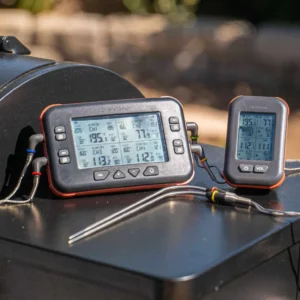
Can I attach the Quad Xpro thermometer body to the smoker door, or will it break it due to the heat?
Can I attach the Quad Xpro thermometer body to the smoker door, or will it break it due to the heat?
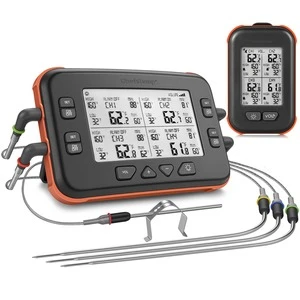
Although it has a magnet affixed to the back, the housing is made of plastic and could potentially melt, therefore, it is not recommended to attach it to the smoker door.
What are some easy go-to recipes for someone who hates cooking but loves food?
What are some easy go-to recipes for someone who hates cooking but loves food?
We have a lot of recipes that don’t need hours of prep or cooking.
See more at: https://www.chefstemp.com/best-cooked-chicken-recipes/
I've tried using my thermometer while cooking Italian Porchetta and it will register that the meat is done, but actually the meat isn't cooked, why?
I've tried using my thermometer while cooking Italian Porchetta and it will register that the meat is done, but actually the meat isn't cooked, why?
If the tip of the thermometer probe is too near the surface of the meat cut or near a bone, you will not get an accurate reading. Experiment with the temp probe placement - it is most accurate when the tip is in the center of the meat portion. If you have several cuts of meat, move the thermometer to several portions to compare how even everything is cooking.
What is the best way to make a crispy fried chicken that stays moist on the inside?
What is the best way to make a crispy fried chicken that stays moist on the inside?
Getting the right temperature is a top priority when it comes to cooking chicken to ensure safety. It is also crucial to make sure that the meat stays juicy, tender, and succulent. It takes a balance between both but once achieved, you can enjoy your chicken however you like to prepare it.
https://www.chefstemp.com/chicken-internal-temp/ In this guide, you will learn the secret to a perfectly cooked chicken.
How to measure your grill’s temperature with an infrared thermometer?
How to measure your grill’s temperature with an infrared thermometer?
- First, place a solid surface such as a cast iron plate or skillet on the grill and let it preheat for 5-10 minutes.
- Next, spray a little cooking oil on the cast iron’s surface to ensure proper emissivity.
- Finally, measure the surface temperature of the plate or skillet with your IR thermometer.
Do you have a table showing with cooking temperatures of different foods?
Do you have a table showing with cooking temperatures of different foods?
ChefsTemp has a full table of cooking temperatures available online that uses the approved FDA Food Guidelines and covers every thing from beef to candies.
See more at: https://www.chefstemp.com/steak-chicken-meat-temperature-chart/
Why does my thermometer show a reading higher than 32°F (0°C) when I put it in ice water?
Why does my thermometer show a reading higher than 32°F (0°C) when I put it in ice water?
This mainly happens because the temperature is higher than the ice point unless you take the time to create a properly made ice bath. If you do however find that, in fact, the thermometer is outside of its published specification, adjust it accordingly based on the instruction manual or contact our Tech Support team for help by emailing [email protected].
What is an IP rating?
What is an IP rating?
An IP rating is a common added feature for electronic thermometers, particularly electronic cooking thermometers. It is a standard for rating instruments based on their ability to protect their electronic components from corrosion by water or dust created by the International Electrotechnical Commission (IEC). The International Protection Rating code (or IP code) consists of the letters “IP” followed by two numbers.
The first number tells you how protected an instrument’s electronics are from penetration by solids (like dust) and the second number tells you how they stand up against liquids according to the following table:
| First number: Protection against solid objects | Second number: Protection against liquids | ||
|---|---|---|---|
| 0 | No protection | 0 | No protection |
| 1 | Protected against solids objects over 50 mm (e.g. accidental touch by hands) | 1 | Protected against vertically falling drops of water |
| 2 | Protected against solids objects over 12 mm (e.g. fingers) | 2 | Protected against direct sprays up to 15° from the vertical |
| 3 | Protected against solids objects over 2.5 mm (e.g. tools and wires) | 3 | Protected against direct sprays up to 60° from the vertical |
| 4 | Protected against solids objects over 1 mm (e.g. tools, wires and small wires) | 4 | Protected against sprays from all directions - limited ingress permitted |
| 5 | Protected against dust - limited ingress (no harmful deposit) | 5 | Protected against low pressure jets of water from all directions - limited ingress permitted |
| 6 | Totally protected against dust | 6 | Protected against strong jets of water e.g. for use on ship decks - limited ingress permitted |
| 7 | Protected against the effects of temporary immersion between 15 cm and 1 m. Duration of test 30 minutes | ||
| 8 | Protected against long periods of immersion under pressure |
Can you test meat cooking temperatures with a laser thermometer?
Can you test meat cooking temperatures with a laser thermometer?
Laser IR Thermometers measure the amount of heat being put out by the food; the laser is used to help you point it to a specific spot to take a temperature. They only measure the surface temperature though. A laser thermometer has no way of reaching the internal portion of the meat where you need to measure the cooking temperature. Laser thermometers are great for measuring the temperature of liquids, soups, water, and pan surface temperatures for things like dry toasting herbs, seeds, chilies, and nuts. A probe thermometer, whether digital or manual, is required to get an accurate internal cooking temperature.
Where should I place my probe tip to gauge doneness?
Where should I place my probe tip to gauge doneness?
When testing doneness in most cooked foods, the coldest part will be the very center of the thickest portion. With larger foods, you can take quick readings with your thermometer in several locations to verify that the entire portion is done. If you are chilling food, the center of the thickest part will be the last to cool. Most digital thermometers have small sensors at the probe’s tip. Penetrate the food you are checking with the probe and place the very tip of the probe where you want to measure.
How do you know if the food is safe to eat and what should be used to check temperature of the food?
How do you know if the food is safe to eat and what should be used to check temperature of the food?
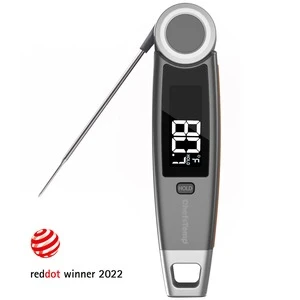
The only sure way to know if foods are safe to eat is by measuring the internal cooking temperature of the food in the thickest part of the food. Instant read thermometers are the most effective means of measuring this temperature. The types of instant read thermometers varies greatly. You have mechanical thermometers which you can insert into the food and take a temperature, you have roasting thermometers that you can leave in the food, you can use a digital probe thermometer such as the Smartro ST 54 which has two probes with leads you can leave inserted in the food and get a constant temperature read as the food cooks, and you can use the ChefsTemp Final Touch X10 instant read digital cooking thermometer as well.
What is the safe temperature for beef rare?
What is the safe temperature for beef rare?
Rare Beef, the recommended lowest safe temperature for serving beef is 135⁰F, which being said, this is the temperature for Medium Rare beef, and if you prefer your beef rare, then this is overdone. Beef is one of the ambiguous foods that does not fit into the normal realm of temperature zones, much is the same with veal and lamb. Rare beef should be cooked to a minimum safe cooking temperature of 125⁰F. this is the lowest temperature where bacterial growth slows down. Always keep in mind the TDZ is designed to keep food safe and to eliminate food-borne pathogens which cause food-borne illness.
What is the minimum internal cooking temperature for seafood?
What is the minimum internal cooking temperature for seafood?
Seafood has a lower minimum internal cooking temperature than other foods. Most seafood, which includes fish, shellfish, and crustaceans need to be cooked to a minimum internal temperature of 145⁰F to kill any bacteria or parasites that might be present in the seafood. The temperature is lower for seafood due to the structure of the protein. This temperature does not apply to sushi grade tuna. It is flash frozen and is safe to be eaten as is. The main concern with fish is anisakiasis, which is a parasitic worm that grows in fish. The freezing process kills the worms and cooking seafood to 145⁰F also kills the parasite or any bacterial concerns.
What’s the best way to get an accurate reading?
What’s the best way to get an accurate reading?
You can get the most accurate temperature by sticking the thermometer into the center of the thickest part of the meat or casserole. Also, make sure it’s not touching any bone or gristle. For whole chickens and turkeys, the thickest part is where the thigh meets the rest of the body. For thin pieces of meat like hamburgers, stick the probe sideways into the meat.
How do I clean and sanitize a probe?
How do I clean and sanitize a probe?
The probe of a thermometer can be cleaned and sanitized using these steps:
- Wash the probe with warm water and detergent.
- Sanitize the probe appropriately (alcohol swabs can be used).
- Rinse the sanitizer away if necessary (refer to the instructions on the sanitizer).
- Allow the probe to air dry or thoroughly dry it with a disposable towel.
My Quad XPro is displaying an LLL error. What does this mean?
My Quad XPro is displaying an LLL error. What does this mean?
If your probe was exposed to temperatures above or below its temperature range (-58 to 572°F / -50 to 300°C), you will see an LLL or HHH error.
LLL means that the probe was exposed to temperatures below its range and HHH means that it was exposed to temperatures above its range.
If the probe is not fully inserted into the socket, LLL or HHH may also appear, please remove the probe, and then re-insert the probe fully.
Another reason may be that the probe or socket is damaged, if the problem still exists after re-inserting, please contact our customer service to get help.
I plugged the probes into my Quad XPro and nothing happened. The display is still dark.
I plugged the probes into my Quad XPro and nothing happened. The display is still dark.
First, make sure that you have turned your Quad XPro on. The ON/OFF switch is on the back of the unit. If that does not work, we suggest replacing the batteries, as a battery change typically fixes these types of symptoms. If the problem still exists, please contact our customer support for further help.
What temperature is a danger zone for food?
What temperature is a danger zone for food?
The Temperature Danger Zone is a temperature range in which bacteria and viruses grow at an accelerated rate based on ideal conditions. The TDZ (Temperature Danger Zone) is 41⁰-135⁰F with the temperature range between 70⁰-125⁰F being the most favorable for bacterial growth. It is important to get food through this temperature range within two hours and to get the food to the recommended cooking temperature for each food as outlined in the food safety guide to kill the bacteria that may have grown on the foods.
WE’RE HERE TO HELP
Still need help?
Contact our support team for help with your ChefsTemp products.