FAQs
If you have any questions about your preferred items that aren't covered here or your order, you can start a chat using the message icon in the lower‑left corner for faster assistance. You're also welcome to contact our Customer Support Team at [email protected].
Order: Why I cannot purchase on your website?
If you encounter issues adding items to the cart or placing an order, please first check whether the product page has fully loaded. Click on the product thumbnails and confirm whether the images switch normally.
- If the images switch correctly, the page has fully loaded, and the add‑to‑cart or checkout process should function properly.
- If the images do not switch, please refresh the page in a stable network environment, try a different browser, or use another smart device.
- If the issue persists, please contact our Support Team with the relevant screenshots, and we’ll resolve it promptly. Thank you!
S1: Why someone said the ProTemp S1 does not fit Big Green Egg grill (BGE)?
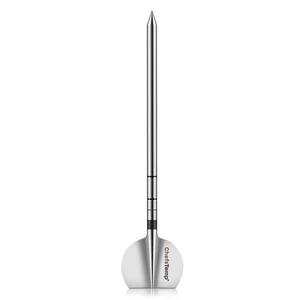
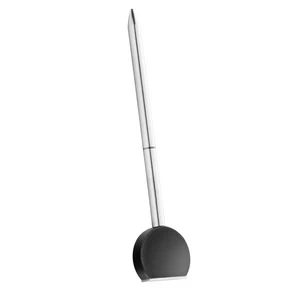
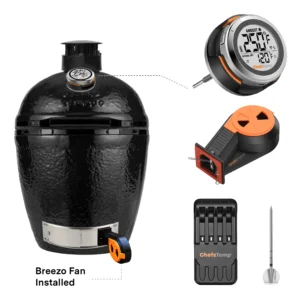
Please choose ProTemp S1 BGE version instead of Universal version. The ProTemp S1 BGE version is specifically made for Big Green Egg grill and other grills with smaller gauge holes like Primo Oval XL, this version has a thinner base stem diameter of 4.1 mm (0.16 inches).
S1: How to charge my S1 safely?
To ensure safe and effective charging for your S1, please kindly note the following:
- Keep ports dry: Before charging, make sure both the S1’s charging port and the charging cable are completely dry and free from moisture or oil.
- Avoid heat exposure: Do not charge the S1 on surfaces that have not fully cooled down, such as recently used stoves. Prolonged exposure to residual heat may compromise device safety.
- Charge before use: Ensure the S1 is fully charged prior to operation. Do not charge the device while it is actively being used on a grill.
- Use the original power sources: Always use the original charging block. Additionally, you can use a 5V⎓2A DC adapter and a Type-C charging cable.
Do infrared thermometers work on liquids?
No. Infrared thermometers cannot measure the temperature accurately if there is glass, liquids, or any transparent surface between the subject and thermometer.
How to use food thermometer?
There are several steps you need to do to use a food thermometer correctly. First, you need to make sure it is accurate to within two degrees, to do this you need to calibrate it. There are two ways to calibrate a food thermometer. The first is to calibrate using the ice water method. this is done by taking a drinking glass, filling it with ice, then adding water to the ice, then you want to insert the temperature probe into the ice water and once it gets to 32⁰ you then press the set button on an instant-read thermometer or turn the dial on a manual thermometer to 32⁰ and ut we calibrated. The second method is the boiling water method, it is not the safest way to calibrate a thermometer but it will work. First, put water in a pan, place the pan on the burner and bring the water to a boil, then place the sensor probe into the boiling water and press the set/to calibrate button and it will set to the water temperature which should be 212⁰. if you are using a manual thermometer you would then turn the dial to 212⁰.
What special precautions do I need to take when using a thermometer and probe?
Never leave a thermometer inside an oven, grill, smoker, or microwave while cooking unless it is specifically designed for this.
Don’t leave your thermometer on the grill hood or close to an open flame.
When checking temperatures above a grill or fire, be careful that the thermometer body does not get too hot.
Some probes are designed to be left inside an oven or grill, but the thermometer housing itself (where the electronic components are kept) typically needs to be kept cool and should only be brought near heat for short periods.
Since flare-ups temperature can be over 537°C which will damage the probe. To avoid damage, please keep probe and cable away from flare-ups, grill lids, grill grates or other hot spots with high temperatures over 250°C.
Why is the transmission range of the XPro thermometer shorter than the manual stated?
Normally, the transmission range is the “best case” range assuming there are no physical barriers between the transmitter and the receiver and no interference from other radio signals. It would be impossible to print a specification that covered “normal” home-user conditions because of the infinitely variable circumstances under which a transmitting thermometer might be used.
Differences in home construction and wall composition is a good example. Concrete, masonry, aluminium siding, metal studs, and metal lathe underneath stucco or masonry are all good inhibitors of radio signals. Interference from other radio signals is also variable (microwaves, cell phones, radio communications, networks, etc.), so the only reliable way to compare device specifications is to give a specification for maximum transmission distance under ideal conditions.
If you want to evaluate whether a manufacturer meets their literal “line of sight” distance claims you should test the device in a rural area with no physical barriers between the transmitter and receiver and little or no interference from other radio signals.
Remember that the more walls and the greater the radio interference the greater the negative impact on your actual transmission distance.
What happens If the probe touches bone?
Meat thermometers have probes with the sensor in the tip of the probe. They are designed to be inserted into the thickest part of the meat and give you a real temperature reading. Bone will be hotter due to the nature of bone, so if you insert a probe and it touches the bone it is going to give you a false reading and the meat may not reach the correct safe internal temperature needed to kill any bacteria that may be present in the food. If you insert the probe and it hits the bone, reposition the probe into the thickest part of the meat. Remember, you need to take temperature readings in several separate locations to determine if the food has reached the correct temperature.
How long can BBQ pork sit out at room temperature after cooking?
Any food cooked to a safe internal temperature of 165⁰F can be put out at room temperature and served. If you do not use chafing dishes with lids to maintain the temperature of 145⁰F to keep the food out of the temperature danger zone, then you have a limited amount of time to leave the food out. BBQ pork can be left sitting out at room temperature, covered, for no longer than 4 hours. After 4 hours the food will need to be refrigerated or reheated. If you choose to reheat the food, you must reheat it to 165⁰F and at this point you could leave it at room temperature for an additional 2 hours, afterwards the food must be discarded. The rule is you can only reheat food once and then any leftovers must be discarded.
Why does my new thermometer read 3-5 degrees different than my old thermometer?
This is most likely because your old thermometer is not as accurate as your new digital thermometer. To confirm this, test both thermometers in a properly made ice bath. After checking, adjust your thermometer accordingly or contact our Tech Support team for help by emailing [email protected].